The Uranium Demand Boom
Nuclear stands to benefit from both the ESG movement and the AI revolution

When formulating the uranium thesis in 2021, I had focused mostly on the supply side of the equation, and the math worked in favor of the bulls, with a significant margin of safety, even if demand stayed flat. What we’re seeing now in terms of demand catalysts and sentiment for nuclear, is quite simply beyond anything I had foreseen. We’re now seeing governments and corporations embracing nuclear in a way the world hasn’t seen since the 1970s, during the first nuclear renaissance. Whether it’s the COP28 meeting last year, the recent statement by the Biden administration regarding the importance of rebuilding a domestic nuclear fuel supply chain in the United States, or the countless new nuclear projects being announced globally, it’s hard for uranium investors to not feel excited about the future of the industry.
Just last month, the Depart of Energy’s (DOE) Loans Program Office approved a $1.5bn loan to finance the restart of Palisades nuclear power plant in Michigan, a 800MW reactor that was shut down in 2022. This will be the first time in history that a shuttered nuclear power plant in the US has been restarted. The plant is now expected to operate until 2051. The operator of the plant, Holtec, is also planning on building small modular reactors (SMRs) on the plant site. The loan funds are supported by the Inflation Reduction Act (IRA).
“Holtec Palisades is the first project to be offered a conditional commitment through the Energy Infrastructure Reinvestment (EIR) program under Title 17 Clean Energy Financing Section 1706, first authorized and appropriated by President Biden’s Inflation Reduction Act. EIR can finance projects that retool, repower, repurpose, or replace energy infrastructure that has ceased operations or enable operating energy infrastructure to avoid, reduce, utilize, or sequester air pollutants or greenhouse gas emissions.”
South Korea announced last month that it plans on extending the operating lifespan of Wolseong Nuclear Power Plant Units 2, 3 and 4, which previously had been on track for closure within the next 2-5 years. All 10 of the country’s nuclear reactors that were slated for closure by 2030 have now had their lives extended from 30-40 years to 70-80 years. Chosun Daily, Korea’s oldest active daily newspaper, had the following to say regarding the announcement [emphasis mine]:
“Prolonging the lifespan of nuclear plants from 40 years to 70 to 80 years is becoming increasingly common worldwide as the rapid growth of artificial intelligence (AI), data centers, and electric vehicles (EVs) is driving up electricity demand. As of the end of last year, 259 out of the world’s 438 active nuclear reactors received approvals for extending their lifespan. Korea was late to join this trend as the former Moon administration, committed to a nuclear phase-out, had previously opted to decommission ten reactors by 2030.”
Korea Electric Power Corporation (KEPCO) has also collaborated with the UAE on Barakah, the UAE’s first nuclear power plant. Barakah’s final unit (Unit 4) came online last month. The plant consists of 4 APR-1400 reactors, with a total generating capacity of 5.6GW. Barakah is a good demonstration of conventional nuclear power being developed at reasonable cost and time in today’s day and age. The four units cost US$24bn vs. original budget of US$20bn, and were completed in 9 years, despite COVID-related delays and Houthi attacks on the plant site.
Indian Oil Corp., an oil refiner and retailer, recently announced talks with India’s state-run Nuclear Power Corp of India to explore the potential for using small modular reactors (SMRs) to power its refineries. Bloomberg wrote the following:
“As several bigger projects face delays, policymakers are promoting small-scale nuclear technology with a capacity of up to 300 megawatts, which is quicker to build and easier to adjust to the requirements of the grid. To boost the nascent sector, the Indian government is considering allowing private firms to manage and operate reactors.”
Nuclear is also increasingly being viewed as the only practical solution to power the AI revolution. A number of prominent technology leaders have stated publicly that energy demand could be THE big bottleneck for AI. Sam Altman, CEO of OpenAI, was recently quoted as saying: “While investor trip all over themselves to get into Nividia, energy is the hardest part”.
Earlier this month, Axios reported that Energy Secretary Jennifer Granholm has accelerated talks with big technology companies on the use of nuclear power, and small modular reactors (SMRs) in particular, to fuel the growing energy needs from AI computing. Fortune published an article recently on the US’ accelerating electricity demand, and the need for significant investment in power generation. The article stated the following [emphasis mine]:
“Data centers—essential for cloud computing—today make up about 2.5% of the nation’s energy consumption. By the end of the decade, their power use is expected to triple, according to Boston Consulting Group, boosted by the growth in AI applications as well as cryptocurrency mines. The International Energy Agency had a similar take, projecting that data centers’ power demands would double between 2023 and 2026. In the U.S., the growth in data centers is responsible for one-third of the added demand in that time period. PJM, an interconnection utility that covers parts of 13 states, from Ohio to Virgiania, has “observed unprecedented data center load growth,” according to Grid Strategies. Virginia contains the U.S.’ largest concentration of data centers, with Loudoun County nicknamed “Data Center Alley.,” The state’s utility, Dominion Energy, has delayed or turned away centers saying it can’t meet power demand, according to industry publication Data Center Dynamics.”
The tech giants have started making significant moves to secure access to nuclear power. Microsoft signed a deal with Constellation Energy last year to provide nuclear power for its data centers. Amazon recently acquired a massive nuclear-powered data center campus. Bill Gates’ backed TerraPower submitted an application for its natrium reactor to the NRC this month.
Why is all of this important for uranium investors? Since the GFC, the US capital markets have had an insatiable appetite for growth stories, and shunned ‘value’ plays. After Fukushima, the uranium sector fell into the ‘deep value’ / ‘terminal decline’ category, and went off the radar for most institutional investors and investment banks. When I first started researching the sector, there was barely any analyst coverage, and most folks who I spoke to were dismissive and/or disinterested in the thesis. The ‘smart’ money was all in renewables, battery storage, EVs and new technologies like green hydrogen. Today, I think we are on the cusp of nuclear / uranium entering broader market consciousness as a ‘growth’ sector. It’s no coincidence that Goldman Sachs recently initiated coverage of Cameco.

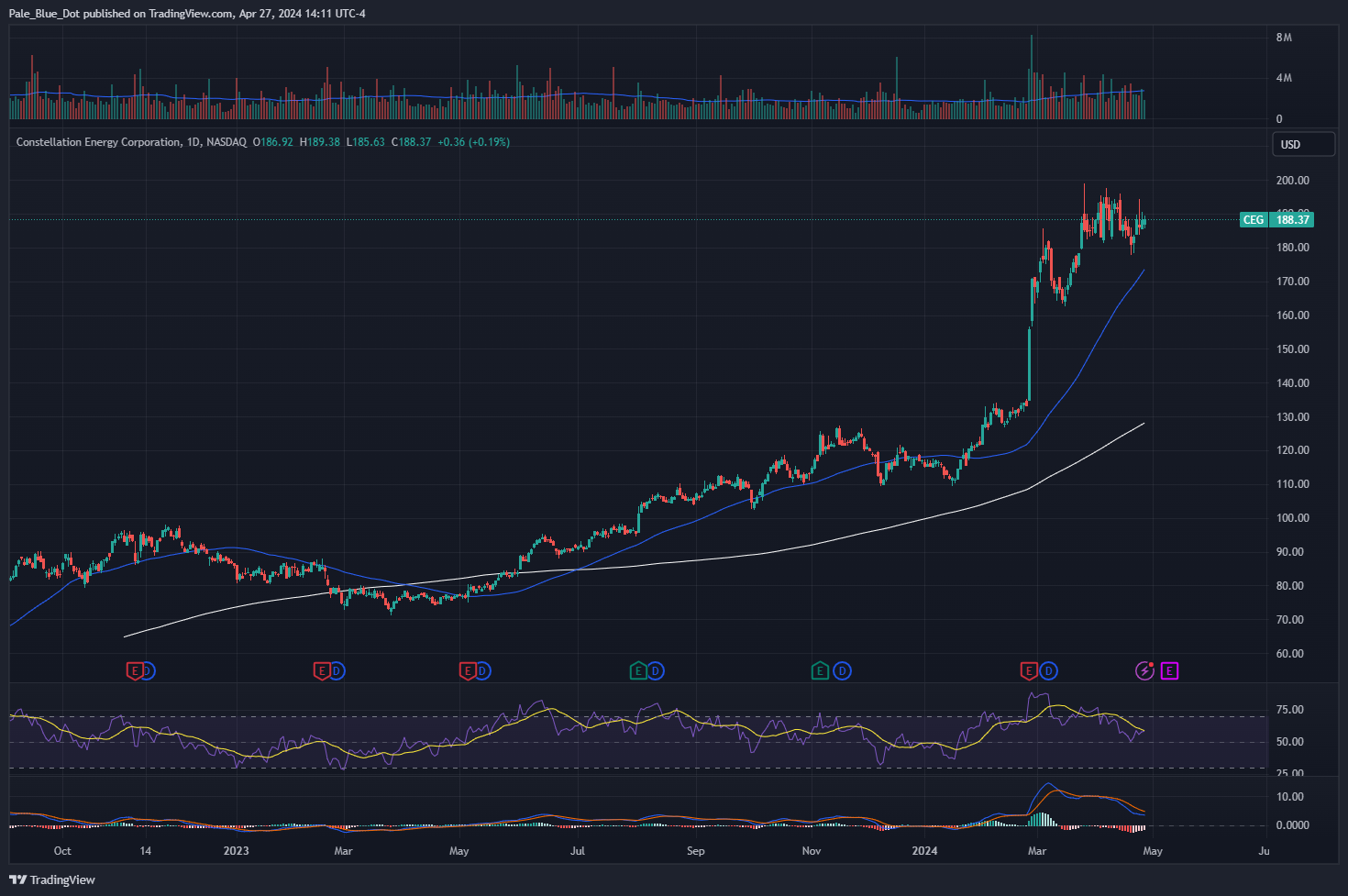
Many generalists who are just discovering the nuclear thesis and still getting up to speed, are choosing to gain exposure through the utility stocks. Liquid stocks like Constellation Energy, a large publicly-traded nuclear utility, are an obvious choice. The stock is +62% YTD. However, as institutional investors dig deeper into the thesis, they will find that the uranium sector is a higher-torque play given the structural supply issues and demand inelasticity. It’s only a matter of time before the large amounts of capital trying to play the AI and ESG themes find a place in the uranium sector, driving stock prices higher, and improving trading volumes / liquidity, allowing other institutions to participate as well. While the consensus seems to be that the best returns in uranium have been made already, I believe the demand / growth story, and the institutionalization of the sector, are just beginning.